
Industrial Tire Classification: How to Choose the Right Industrial Tire?
1.Summary:
Industrial vehicle tires are tires designed for industrial equipment such as forklifts, lift trucks, tow tractors, flatbed carriers, and fixed-platform handling vehicles. In practical applications, selecting the correct tire structure is the key to improving safety, uptime, and cost control. This article explains the typical classifications of industrial tires and the usual applications of different types of industrial tires.
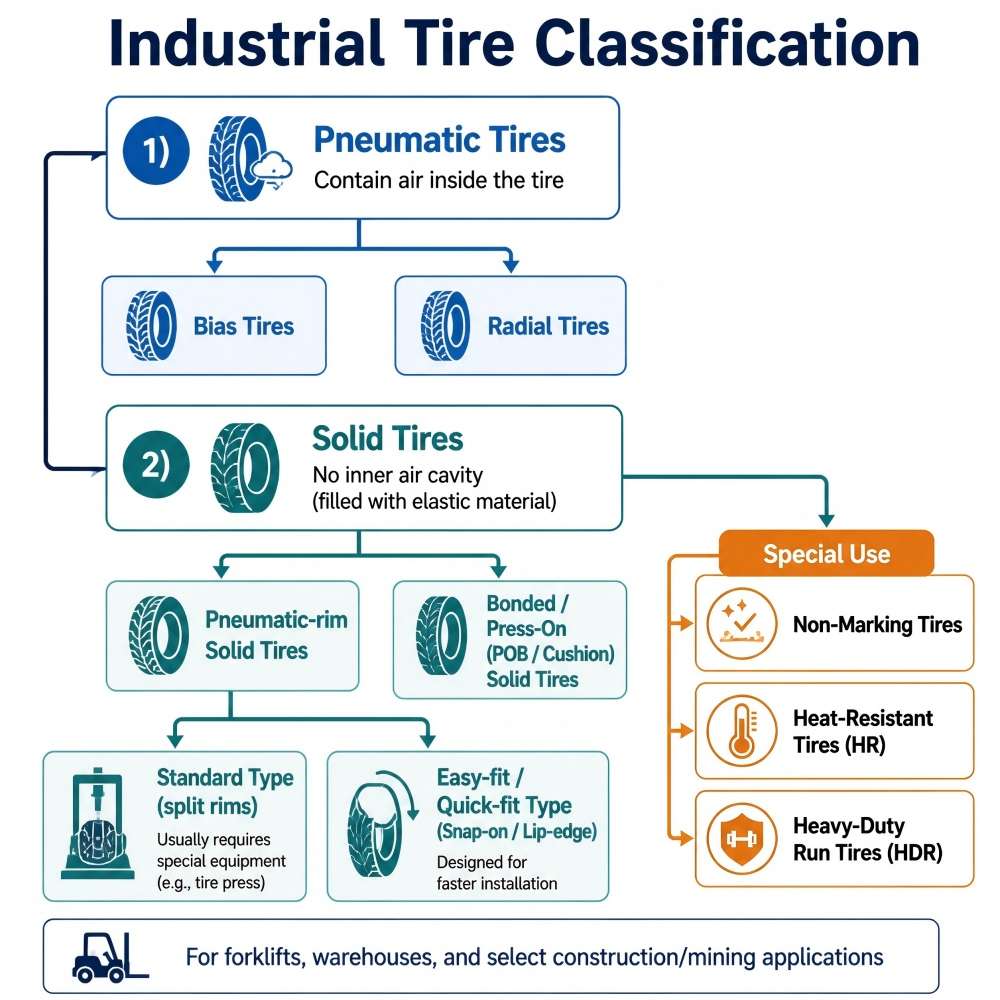
2. Main Categories: Pneumatic vs. Solid Tires
2.1 Pneumatic Tires
Pneumatic industrial tires contain air inside the tire.
Benefits
- Generally more affordable
- Better shock absorption for improved comfort and ride stability
When Pneumatic Tires Work Best
- Indoor warehouse and yard operations where the ground is relatively clean
- Applications where puncture risk is lower
Considerations
In harsh environments—such as steel works, glass factories, waste/slag areas, construction sites, and mining sites—sharp debris may puncture pneumatic tires, which can lead to downtime for repair or replacement.
By Internal Construction, Pneumatic Tires can be further classified into: Bias and Radial Tires. If you want to learn more about the difference between Bias and Radial Tires, check: Radial Versus Bias Tires Difference: Pros and Cons
2.1.1 Bias Pneumatic Tires
- Built with nylon cord plies arranged diagonally between tire beads
- Often offer a wider range of tread pattern options
- Commonly used in forklift and general industrial applications
2.1.2 Radial Pneumatic Tires
- Features steel cord plies running perpendicular to the rolling direction (bead to bead)
- Commonly designed for better heat resistance and lower rolling resistance
- Often used when customers require higher efficiency and durability (and they usually come at a higher cost)
- In many industrial product lines, radial versions are typically available primarily as pneumatic tires
2.2 Solid Tires
Solid tires are filled with resilient elastic materials and have no inner air cavity.
Benefits
- Typically eliminates downtime caused by air loss
- Helps improve operational stability where punctures are more common
Considerations
- Installation often requires special tools/equipment, depending on the tire type and wheel/rim design
By Construction & Installation, Solid tires can generally be divided into
- Pneumatic-rim solid tires
- Bonded / Press-On solid tires (Press-On, POB, Cushion)
2.2.1 Pneumatic-rim solid tires
- Can be used on rims that are suitable for pneumatic tire applications
- Usually designed to match common rim types without requiring a totally different wheel system
Pneumatic-rim solid tires can be further divided by installation structure:
- Standard Type (for Split Rims)
- Easy Fit/Quick Fit Type (Snap-on / Lip-edge)

2.2.1.1 Standard Type
- Used with split rims made of multiple components
- Installation usually requires more force and specialized equipment, such as a tire presser
- Typically more time-consuming and labor-intensive

2.2.1.2 Easy-fit / Quick-fit Type
- Designed for faster installation on compatible rims
- Often used to reduce downtime during replacement

2.2.2 Bonded / Press-On solid tires (Press-On, POB, Cushion)
- Requires special rims
- In many cases, the tire is bonded onto a wheel component (steel band/rim band) during installation
3. Special Use Solid Tires (Common for Forklifts & High-Value Environments)
3.1 Non-Marking Tires
For environments where leaving marks, dirt, or residues on floors is a concern—such as food, medical, clean warehouses, and exhibition venues—non-marking tires (often beige or other custom colors) help reduce visible scuffing.
3.2 Heat-Resistant Tires (HR)
Heat-resistant solid tires use a special rubber compound for higher-temperature environments.
The exact temperature capability depends on compound design and operating conditions.
Sidewall markings may include HR.
3.3 Heavy-Duty Run Tires (HDR)
Heavy-duty run tires are designed for long continuous operation in demanding warehouse/production settings such as paper mills, beverage plants, and ceramic factories.
The achievable operating hours depend on load, speed, and floor conditions.
Sidewall markings may include HDR.
How to Choose the Right Industrial Tire (Quick Guide)
- If puncture risk is low & comfort matters: consider pneumatic tires
- If puncture risk is high & uptime is critical: consider solid tires
- If your operation requires clean floors / minimal visible marks, consider non-marking tires
- If you work in hot environments, consider heat-resistant (HR) solid tires
- If you need continuous high-hour operation, consider HDR heavy-duty run tires
FAQ
- Q1: Can solid tires replace pneumatic tires?
Often yes, but it depends on your equipment, rim/wheel compatibility, and installation method. We can help confirm fitment based on tire size and wheel type. - Q2: Why do solid tires usually require special installation?
Because solid tires are often heavier and designed for specific rim structures. Some types also need a tire presser or specialized installation tools. - Q3: Are non-marking tires only for forklifts?
Non-marking tires are commonly used on forklifts, but they can also be suitable for other industrial vehicles where floor cleanliness is important.



Need A Quote?
If you share your equipment model, tire size, operating environment (floor type + temperature + debris level), we can recommend the most suitable tire structure and tread option for your application.