
What Is a TRA Code for OTR and IND Tires?
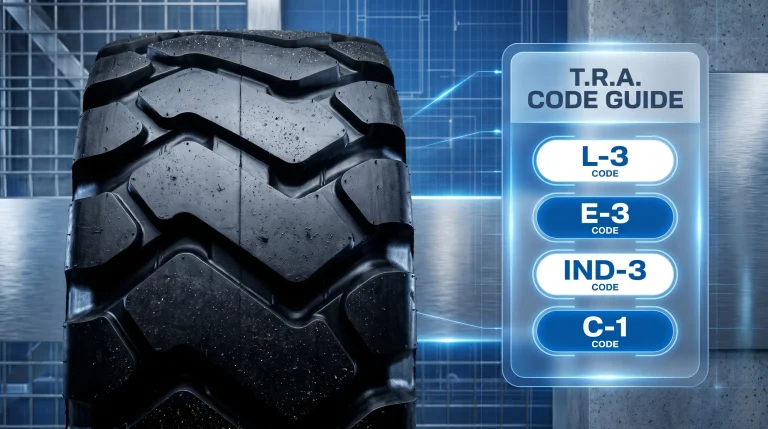
If you work with off-the-road (OTR) or Industrial (IND) tires—mining, construction, ports, industrial yards—you’ll often see TRA Code in tire data, catalogs, and fitment references.
TRA Code is a standardized tread designation used for OTR tires, validated by international bodies such as the Tire and Rim Association (TRA). It typically consists of:
- a letter (representing the machine type / tread design family), and
- a number (representing the tread depth classification/level for that tread design).
This structured code helps buyers and distributors match the right tread to the equipment and operating conditions—supporting traction, stability, and service life.
1) Why TRA Code Matters for OTR Tire Selection
OTR and IND tires operate under harsh conditions. The “right tread” is not only about grip—it’s about how the tire handles:
- wear on abrasive ground
- cut resistance where sharp aggregate is present
- shock burst resistance under impacts
- puncture resistance in industrial/yard environments
- and proper traction/flotation behavior depending on the jobsite
A correct TRA Code match helps reduce premature wear caused by tread design mismatch.
2) How to Read TRA Code: Letter + Number
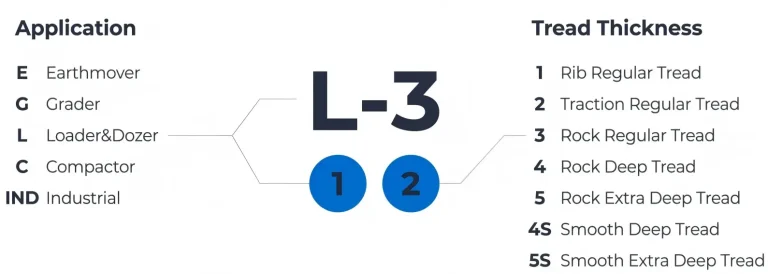
2.1 The letter = machine type / tread design family
The letter groups tread designs by the type of equipment they’re intended for (e.g., earthmover/haul-type, loader/dozer-type, grader/leveling-type, compactor-type, industrial/yard handling-type).
In practice, the letter reflects the Tread family’s performance focus.
2.2 The number = tread depth classification (Regular / Deep / Extra Deep)
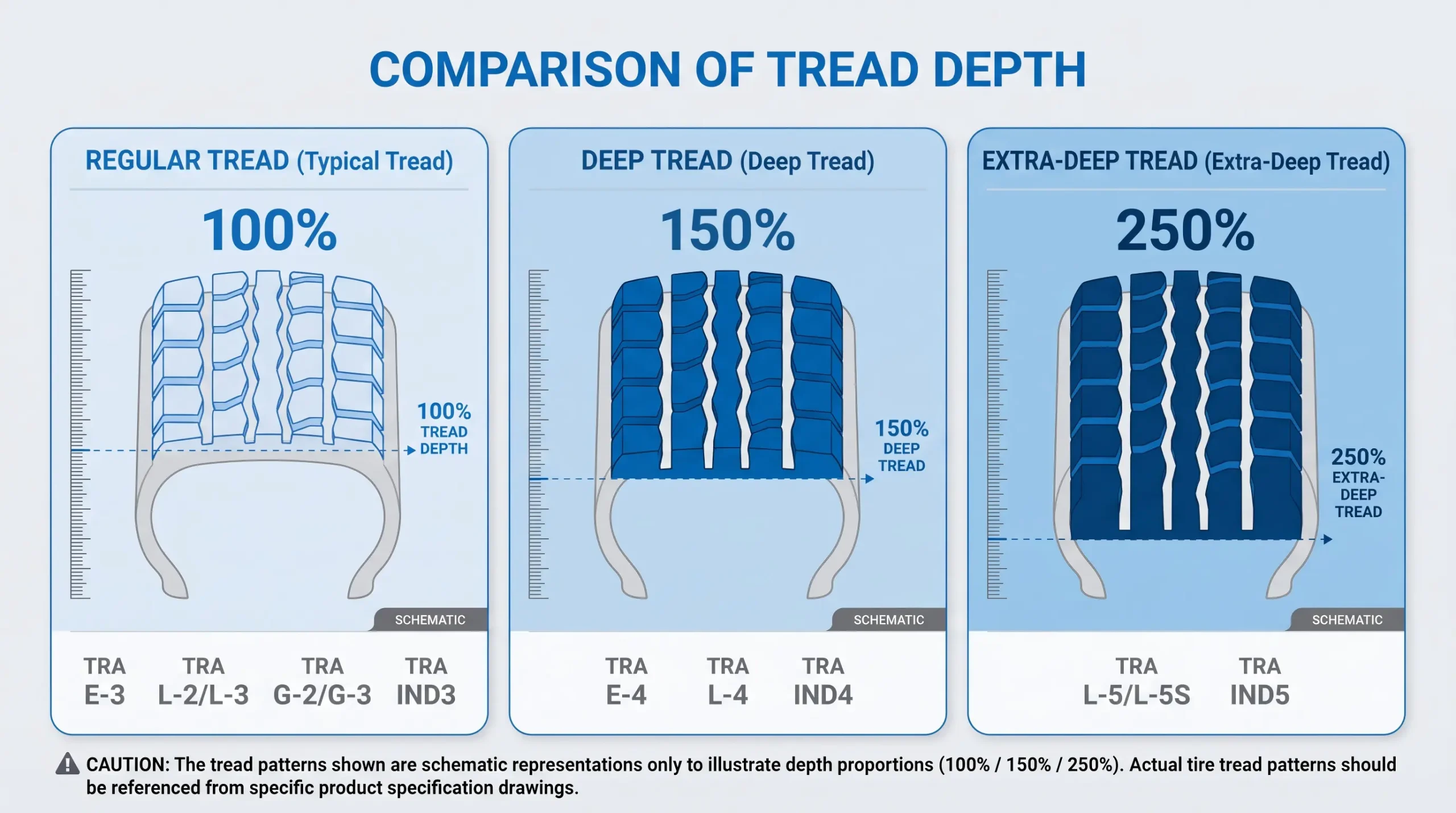
The number is tied to the tread depth level of that tread family. Different depth levels are commonly categorized as:
- Regular Tread (baseline)
- Deep Tread (approximately 150% of Regular)
- Extra Deep Tread (approximately 250% of Regular)
- 26.5R25 GLR02 L-3 Tread Depth 36mm
- 26.5R25 GLR06 L-4 Tread Depth 53mm
- 26.5R25 GLR08 L-5 Tread Depth 83mm
Why tread depth classification matters: deeper tread typically provides a larger working tread volume, which can help maintain traction characteristics as the tire wears—especially in jobs with long operating cycles and demanding surface conditions.
Always confirm the exact depth level definition and performance expectations using the specific tire reference/datasheet.
3) Common TRA Code Families (What They’re Typically Built For)
Below is a practical overview of how different TRA Code families are commonly used in the industry (exact applications can vary by tire model and reference standard):
- Earthmover-type (often “E”): haul/transport and general earthmoving-type duties
- Loader / Dozer-type (often “L”): pushing, scraping, loading across mixed ground
- Grader / leveling-type (often “G”): grading, leveling, and controlled ground interaction
- Compactor-type (often “C”): compaction work requiring tread durability and wear resistance
- Industrial / yard equipment (often “IND” and related families): handling and repetitive yard operations
(and sometimes specialized applications such as port/industrial environments)
| Service | Vehicles | T.R.A. Code | Tread Type |
|---|---|---|---|
| Loader and Dozer |  Loader & Dozer  LHD  Backhoe Loader  Skid Steer Loader | L-2 | Traction Regular Tread |
| L-3 | Regular Tread | ||
| L-3S | Smooth Regular Tread | ||
| L-4 | Deep Tread | ||
| L-4S | Smooth Deep Tread | ||
| L-5 | Extra Deep Tread | ||
| L-5S | Smooth Extra Deep Tread | ||
| Earthmover |  Articulated Dumper Truck  Excavator  Mobile Crane  Rigid Dumper Truck  Wide Body Dumper Truck  Seismic Vibrator(Sandy Tire) | E-2 | Traction Regular Tread |
| E-3 | Regular Tread for | ||
| E-4 | Deep Tread | ||
| E-7 | Flotation Tread | ||
| Grader |  Grader | G-2 | Traction Regular Tread |
| G-3 | Regular Tread | ||
| Compactor & Road Roller |  Compactor & Road Roller | C-1 | Smooth Tread for Compactor |
| C-2 | Grooved Tread for Compactor | ||
| C-7 | Flotation Tread for Compactor | ||
| Industrial |  Container Handler  Forklift  Gantry Crane  Reach Stacker  Straddle Carrier | IND-3 | Regular Tread |
| IND-4 | Deep Tread | ||
| IND-5 | Extra Deep Tread |
4) Dual Marked Tires: Using One Tire for Two Applications
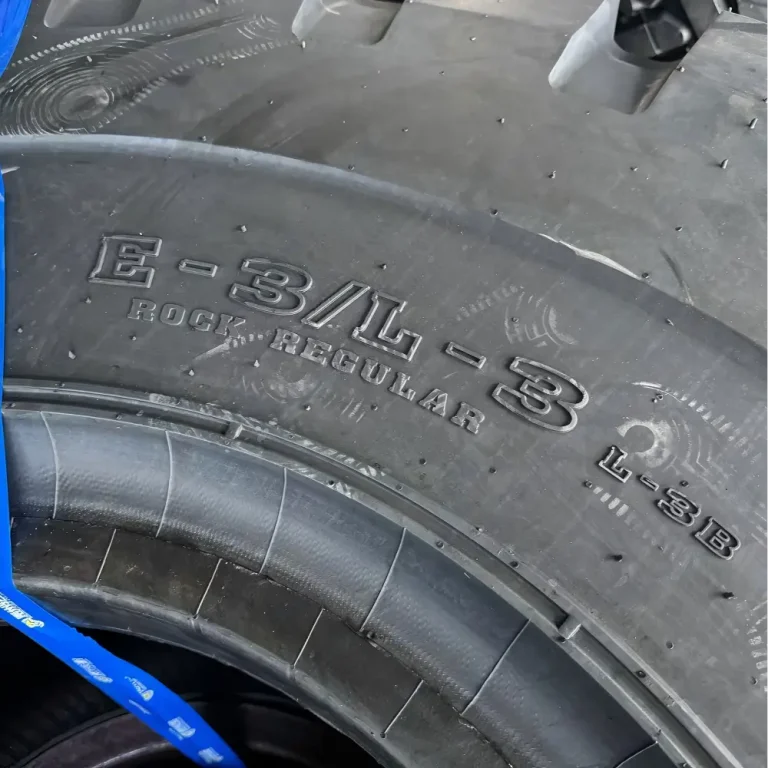
Some OTR tires are designed to serve both haulage and loader applications and therefore carry “dual” markings.
What “dual marked” means
A dual marked tire is labeled with two TRA designations (for example, a tire may be marked as E-3 and L-3). This indicates that the tire can be used in two different equipment/application categories—but only within the correct specification conditions.
Example (concept): A tire such as E-3 / L-3 can be used as:
- a loader tire (L-3), and
- a haulage tire (E-3),
so it carries both markings.
Critical safety/selection note: It is imperative that the correct load and inflation table is referenced according to the application.
- Tires marked E-3should not be treated as L-3 for an L-3 application unless the tire is specifically dual marked and the correct table/conditions are used.
- The reverse also applies: do not assume E-3 and L-3 share the same operating limits.
5) How to Choose the Right TRA Code (Simple Method)
Use this workflow:
- Identify the machine type/work category
Choose the TRA letter family that matches the machine’s duty (earthmover, loader/dozer, grader, compactor, industrial). - Select the tread depth level (the number)
Match the tread depth classification (Regular / Deep / Extra Deep) to your service intensity and expected wear profile. - Confirm jobsite conditions
Decide which factors dominate:- abrasive rock → wear/cut resistance becomes critical
- mixed impacts → shock burst resistance matters
- loose ground → traction/flotation behavior matters
- industrial handling risk → puncture/abrasion become critical
- Verify the full tire requirements
Even with the right TRA Code:- tire size must be correct
- load capacity / ply rating must match
- speed rating / service type must match
- installation/rim compatibility must be confirmed
If dual marked: always use the correct table for the correct application. Don’t mix up E/L duty tables just because the tire has dual markings.
FAQ
- Q1: Is TRA Code the same as tire size?
No. TRA Code is a tread designation (letter + depth level). Tire size and ratings (load/speed) are separate requirements.
Q2: What does the number mean in TRA Code?
It indicates the tread depth classification/level (e.g., Regular / Deep / Extra Deep). Deep and Extra Deep are commonly described as approximately 150% and 250% of Regular tread depth, respectively (as defined in reference materials for that tread level category).
- Q3: What are dual marked tires?
They carry two TRA designations (e.g., E-3 / L-3), meaning the tire can be used for two application types—but you must use the correct load & inflation table and operating conditions for the chosen application.
Need A Quote?
If you share your equipment model/tire size and destination, we can recommend the most suitable tire and available freight options for your application.